
Running Kubernetes on your own infrastructure leaves your team responsible for more than deploying applications: machines, cluster upgrades, networking and recovery also need attention. Platform products bundle or manage different parts of that work.
OpenShift is Red Hat's Kubernetes application platform, with an integrated set of development and operational components. Rancher Manager manages Kubernetes clusters; it is distinct from distributions such as RKE2 that run those clusters. Pivotal PKS is a historical Kubernetes product name, so its current successor and support path need to be established before making a new purchasing decision.
For OpenShift versus Rancher, evaluate OpenShift when you want its integrated platform and support approach. Evaluate Rancher when managing clusters through its supported distribution and management choices fits better. Compare the actual installation and support scope: a cluster manager alone does not supply every component of an application platform. The original PKS comparison below is preserved as history.
List the work your team will still do
The original product names and releases are historical. Compare a current supported distribution by who operates control planes, node images, networking, storage, identity, upgrades and disaster recovery. Product branding can change without making an old feature table current.
The original Rancher recommendation used RKE1, whose published end-of-life date was July 31, 2025. Rancher Manager is the cluster-management platform; RKE1 and RKE2 are Kubernetes distributions, not names for its user interface. SUSE describes moving from RKE1 to RKE2 as replatforming onto new clusters, not an in-place upgrade. Include workload and persistent-data migration in that plan.
Start with hardware, virtualization, disconnected-network and support constraints. Require a demonstrated upgrade and restore using the intended topology. Include registry mirroring, certificate renewal and replacement of failed hardware. A managed user interface does not remove the underlying operational work. Revalidate commercial support and licensing with each vendor before using the historical shortlist.
Historical Kubedex content
Original publication: 2018-10-12T12:19:35+00:00. Preserved for context. Commands, versions, prices and results below reflect the original research.
Last Updated on December 22, 2018
This is a tough comparison as there are so many options and nobody is going to have the time to trial them all. So what I’ve attempted to do is crowd source information and rationalize down the options to a smaller number based on differentiating features.
After a long period of mental distillation I’ve selected to compare OpenShift, Rancher and PKS. The elephant in the room is always custom installers for which there is no direct comparison. Steve the DevOps guy could choose to manually type in KubeADM commands, or use Terraform, Ansible, Puppet, or bash scripts.
I’m going to assume that if you have a data centre you’re probably a reasonable size company with some budget. If you have a strong technical team already then they won’t need my help deciding what to use and may well go custom. This blog is for On-Prem Kubernetes selection when you’re just starting out and would like to de-risk Steve setting it all up and leaving.
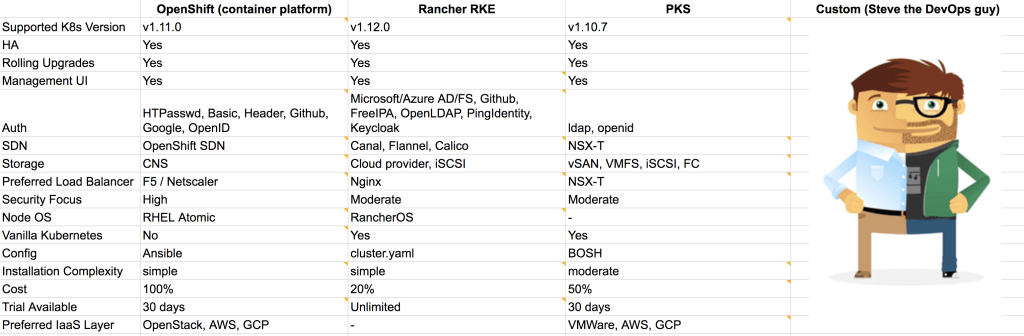
Above is my analysis to date. You can see the raw spreadsheet here. You will notice that literally everyone has edit rights to that sheet. If you feel I have missed out your preferred option please update the sheet and I’ll add it to this blog, and if the information is compelling I will change my mind.
What would be massively helpful is if you could call out a clear differentiator for why anyone would pick another option over the three I have listed here. Something major as a unique selling point. As far as I could tell every option outside of the three I chose are simply me-too’s.
When adding a unique selling point please also remember who you’re dealing with. I don’t suffer marketing bullshit on this blog.
Let’s take a brief interlude into what a proper research company thinks as it’s always useful to see another source of data. There was a recent report carried out by Forrester entitled “Enterprise Container Platform Software Suites, Q4 2018“. They have the infamous magic quadrant, or a variation of it.
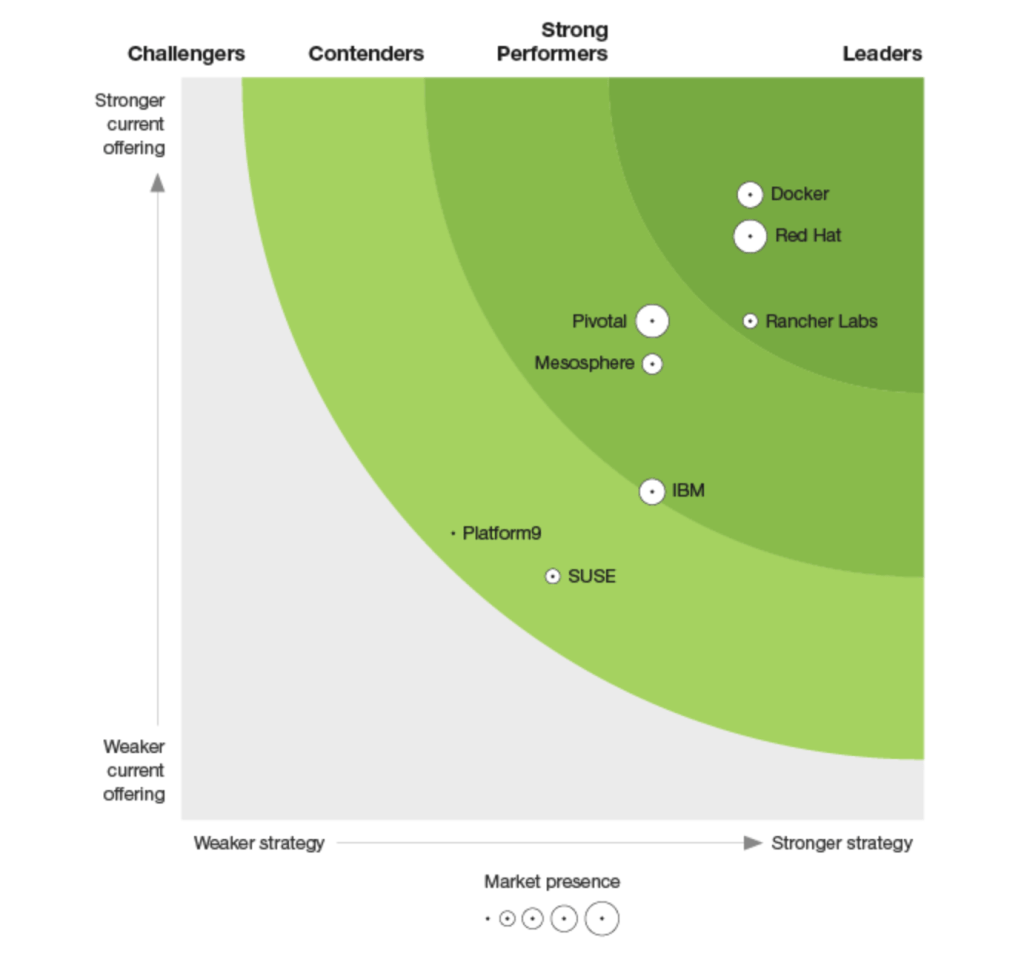
Forrester put Docker Enterprise, Redhat OpenShift and Rancher as the leaders. When you look at the size of the bubbles it shows Redhat, Pivotal, Docker and IBM having the most market presence.
So why didn’t I include Docker and IBM in my comparison? I honestly couldn’t see a reason why you would use them. The marketing is all identical to Redhat and Pivotal, and yet Redhat and Pivotal have specific functionality that make them more compelling.
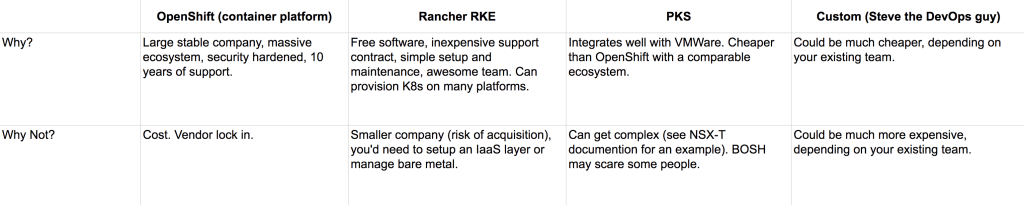
I’ve compiled a quick table to help people decide. We’ll cover some of the points that people may like to debate from this table and then I’ll finish up with my recommendation.
Firstly, let’s cover costs. These are always subject to change and I know behind the scenes that Redhat are working on a usage model that may alter things in future. However, today, if you were to get a quote for OpenShift you’d be looking at approximately $1200 per virtual core per year. Add on top of that the cost for professional services and training. You only need a couple of 50 virtual core clusters to reach $1m+ per year in software licensing costs alone.
Now I’m not saying that’s bad value for money. You get a lot of software and support when you go with OpenShift and it may work out less expensive and risky than recruiting a team of Kubernetes experts to build and operate your platform. On the flip side of that you do get massively locked-in from a sunken cost perspective. I’ve helped build a vanilla Kubernetes platform from scratch and I wouldn’t be qualified to administer OpenShift without a training course and experience. OpenShift simply adds so much Redhat specific stuff around Kubernetes that you end up isolated from a technical perspective.
There’s also no denying that OpenShift is the gold standard for security hardened Kubernetes. Out of the box containers don’t run as root, and they have locked down every interface with auth.
Pivotal has similar problems from a lock-in perspective. However, I’d argue that if you’re on VMWare you’re probably locked in already. The list price costs for Pivotal PKS are around $800 per pod and will probably come in at around 50% of the total cost of purchasing OpenShift licenses for the same size clusters. The benefits of PKS are really around the integration with vSphere, the SDN and the storage.
I do know of one company who are running VMWare that still went with OpenShift. They are a mix of on-premise VMWare and AWS / GCP for cloud.
Regarding the differentiators I have a couple of quotes from the platform architect.
“PKS is way behind Openshift. Openshift has the CNS (container native storage) which can used with Gluster, VMWare, EBS etc.”
“On the OpenShift platform you have access to the RH images which are performance tuned for containers. We ran one from Docker for JBOSS and one from Redhat. The Redhat one was 11% faster.”
From a technical perspective I assume both factors there could be eventually worked out on both platforms. It is interesting however that Redhat are playing to their strengths in big enterprise with optimisations across the entire stack including at the operating system level.
My Recommendation
Rancher.
I didn’t spend a lot of time talking about Rancher on this blog. This is really because there’s not much to say from a negative perspective and therefore much fewer statements to qualify.
Why would I choose Rancher over everything else? I see Rancher as the best, simplest technical choice.
Some may see the lack of IaaS integrations as a weakness whereas I suspect anyone running a data centre nowadays probably has a method to image servers and network them together. Rolling out RancherOS, or using an existing Linux image with Docker on it is the only prerequisite. From that point creating a Rancher 2.0 cluster using RKE is a simple matter of updating a yaml file and running rke up.
You’ll need to configure all of the networking and storage yourself outside of Rancher. Again, I quite like this. You probably already have a proficiency with your on-premise routers and SANs. You can simply skip learning the vendor lock-in stuff from Redhat and Pivotal. Now people may argue that you could do that with any cluster, but I’d respond by asking then what are you paying for?
The other cool thing to know is that Rancher RKE (the management UI) actually works with any Kubernetes cluster. Not just Rancher 2.0 clusters. If you decide to go hybrid then you can spin up clusters in other clouds.
Let’s tackle the Redhat marketing absurdity regarding hybrid cloud. If you are moving to the cloud then the best end result is to simply use the Kubernetes service that they offer. Google GKE is awesome and production ready right now. Azure AKS and AWS EKS are both iterating at a reasonable speed and will become defacto no-brainers for Kubernetes cluster choices on those platforms within the next year.
If that’s your end goal why would you lock yourself into a solution like OpenShift and PKS on-premise now? You’re literally creating a complex migration project for no reason, or worse, you’re getting conned into running these solutions at added expense in the cloud when there is no reason to.
The only reason I can think for using OpenShift and PKS is if you have a long term strategy of always running a data centre.
Final Words..
Dread it. Run from it. Google GKE On-Prem still arrives. I’m actually looking forward to seeing what this looks like. Google aren’t well known for their on-premise software so it may turn out to be a total failure. The connection between On-Prem clusters and the GKE web console looks quite cool. This blog will undoubtedly get updated once it’s released.
Historical workbook values; blanks mean unknown, not No. Prices, versions, maturity labels and feature claims are not current recommendations.
Kubernetes On-Prem Comparison / Platforms (historical)
Historical snapshotRecovered comparison data. Versions, prices and availability describe the original research, not a current benchmark. Blank or damaged source values are marked unknown.
Choose columns
| Feature / source label | VMware Enterprise PKS | OpenShift Container Platform (v4.1) | Anthos On-Prem (GKE On-Prem) | Mesosphere Kubernetes (MKE) | Rancher | Charmed Kubernetes | MicroK8s | Kubermatic | SUSE CaaS Platform v4 | MetalK8s | IBM | DaoCloud Enterprise | Platform9 | Giant Swarm | Nirmata | Mirantis Cloud Platform | Kublr | Docker Enterprise | Nutanix | Cisco Container Platform |
|---|---|---|---|---|---|---|---|---|---|---|---|---|---|---|---|---|---|---|---|---|
| Company | Pivotal/VMware | Red Hat | Mesosphere | Rancher Labs | Canonical | Canonical | Loodse | SUSE | Scality | IBM | DaoCloud Inc. | Platform9 Systems | Giant Swarm | Nirmata, Inc | Mirantis | Kublr | Docker | Nutanix Karbon | Cisco | |
| Kubernetes GA Versions | v1.13.5 | v1.13 | v1.14 | v1.13.5 | v1.13.5 | v1.19 - 1.14 | v1.19 - 1.14 | v1.13 | v1.15 | v1.11 | v1.11 | v1.10 | v1.10 | v1.12 | v1.13 | v1.12 | v1.14.7 | v1.8 | Unknown | Unknown |
| SDN | NSX-T | OpenShift Multi-Tenant SDN (based on OVS), plus CNI-compliant network plugins (Flannel, Nuage, Essentials (Calico), Open Contrail, Cisco Contiv, BigSwitch, VMware NSX-T, OVN, and Kuryr for OpenStack network integration) | Calico + NSX-T | Calico | Canal, Flannel, Calico, Weaveworks | Canal, Flannel, Calico, Tigera Secure EE, and CNI plugins | Host bridge, Cilium | Canal, Calico | Cilium | Calico | Calico | Calico, MacVlan, Flannel | Calico, Weave, Flannel, OpenContrail | Calico, Flannel | Flannel, Calico, Cloud Provider | Calico, Tungsten Fabric | Calico, Canal, Flannel, Weave, generic CNI | Calico | Unknown | Unknown |
| Storage | vSAN, VMFS, iSCSI, FC | OpenShift Container Storage (OCS), as well as native support for CSI plugins, NFS, iSCSI, Fiber Channel, OpenStack Cinder, FlexVolume, GlusterFS, Ceph RBD, Azure Disk, Azure File, AWS EBS, GCE Persistent Disk, VMware VMDK | vSAN, VMFS, any CSI compatible or supported by Kubernetes | CSI, local, Portworx | All volume types supported by Kubernetes | Ceph, NFS, iSCSI, FTP, hostpath. NetApp Trident (OnTAP, Santricity, etc), StorageOS and Pure. Cloud storage on Openstack (Cinder), AWS (EFS/EBS), GCP Persistent Disk, Azure | Host path | Custom | SUSE Enterprise Storage (Ceph), NFS, hostpath | Native LVM, NFS, custom | Unknown | NFS,Portworx | Unknown (damaged historical cell) | NFS, iSCSI | Cloud Provider, Rook, Portworx, Nutanix, NFS | Ceph, Rook, EMC, NetApp, etc. | Rook/Ceph, any CSI compatible or supported by Kubernetes | NFS | Unknown | Unknown |
| Security Focus | Moderate | High | High | High | High | High | High | Moderate | High | Moderate | Unknown | Unknown | Unknown | High | Unknown | Unknown | High | High | Unknown | Unknown |
| Node OS | Ubuntu | RHEL CoreOS and RHEL 7/8 | Ubuntu, COS (Container Optimize OS) coming soon | Linux - various | RancherOS, K3OS, Ubuntu, RHEL, Debian, Fedora, OpenSUSE, CoreOS | Ubuntu - x86, ARM, Z | Ubuntu, Debian, Fedora, Arch, other Linux (AMD64 and ARM64) | Ubuntu, CoreOS, Container Linux | SLES 15 SP1 | CentOS | Ubuntu | Linux | Linux - CentOS, RHEL, Ubuntu all supported | CoreOS | CentOS, RHEL, Ubuntu | Ubuntu | RHEL, CentOS, Ubuntu, Debian, SuSE | CentOS, OEL, RHEL, SLES, Ubuntu, Windows, (incl s390x and ppc64le) | Unknown | Unknown |
| Vanilla Kubernetes | Yes | NO | Yes | Yes | Yes | Yes | Yes | Yes | Yes | Yes | Yes | Unknown | Yes | Yes | Yes | Yes | Yes | Yes | Unknown | Unknown |
| Installation Complexity | moderate | simple | simple, automated via gkectl | simple | simple | simple | simple | simple | simple | simple | simple | simple | simple - a SaaS managed service | SaaS, or consulting deployment | simple - SaaS | Unknown | simple | simple | Unknown | Unknown |
| Managed Offerings | Unknown | OpenShift Dedicated (on AWS and GCP), Azure Red Hat OpenShift, Atos Managed OpenShift, T-Systems AppAgile, Telstra OpenShift Dedicated | Fully managed + Cloud GKE fully managed on GCP | Unknown | None | Yes. Fully Managed Kubernetes on bare metal, VMware, AWS, OpenStack, Azure, Google, Oracle Cloud | Unknown | Unknown | Unknown | Unknown | Unknown | Unknown | Unknown | Unknown | Unknown | Unknown | Kublr Cloud, Kublr Accelerators | Unknown | Unknown | Unknown |
| Cost as a % of OpenShift | 0.5 | 1.0 | Subscription per vCPU/node | Unknown | Unknown (damaged historical cell) | 0.2 | 0.2 | Unknown | Unknown | Free | Unknown | Unknown | Unknown | Subscription per DC + node | Subscription per year | Subscription | ~20-50%, Subscription | 0.3 | Unknown | Unknown |
| Trial Available | 30 days | 30 days - 60 days | PoC possible (Ask Sales) - Fully autonomous coming soon. | Open Source - yes, forever DC/OS Enterprise - Eval and PoC available | Unlimited | Free, optional support from Canonical | Free, optional support from Canonical | online demo system | 60 days with updates | Free with no support | Yes | Unknown | Unknown | PoC possible | Yes (SaaS), PoC (On-prem) | Unknown | Yes; free unlimited trial license; PoC | 30 days | Unknown | Unknown |
| Supported On-Prem IaaS Layer | VMware | Bare Metal, OpenStack, VMware | VMware, Bare Metal workers coming soon | Bare metal, penStack, HyperV, RHV, Vmware | Unlimited | Bare metal, Openstack, KVM, VMware. | Any | OpenStack, VMware | Bare metal, KVM, Xen, VMware vSphere/ESXi, Microsoft HyperV, SUSE | Bare metal, VMWare, OpenStack | - | Bare metal, VMWare, OpenStack | Bare metal, VMware, OpenStack | Bare Metal, VMware | Bare Metal, VMware | Bare Metal, OpenStack | Unknown | VMware | Unknown | Unknown |
| Cost | $500 per pod (application) | $1200 per virtual core (workers only) - Two pricing models (OCP and OpenShift Container Engine (OCE), as well as Managed Service Offerings. Pricing is dependent on capabilities and usage of the platform. | Ask Sales | Unknown | Free and open source. Enterprise subscription (support and other benefits) available but not required. | Free and open source. Support available for: $1500 per server, $500 per VM | Free and open source. Support available for: $1500 per server, $500 per VM | Unknown | Unknown | 0.0 | Unknown | Unknown | Unknown | 0.2 | Unknown | Unknown | Starting at $1000/mo | Docker EE for RHEL - Advanced $2400 per Node | Unknown | Unknown |
| Config | BOSH | All native Kubernetes tools - Operators and machine controllers to automate full stack provisioning and config of your cluster, including underlying cloud infra, OS hosts, kubernetes masters and workers and all integrated services. | Automated via gkectl, updated via custom CRD and YAML configuration files. | Terraform + Ansible for DC/OS installation. Full Service Automation for Mesosphere Kubernetes Engine | RKE is provisioned through a YAML configuration file. Rancher installs into an RKE cluster. Nodes provisioned by Rancher are configured through the Rancher UI. | Automated | Single-package | CRD | Salt | Ansible | Unknown | Unknown | Unknown | CRDs + Ignition + PXE | Unknown | Salt | Kublr API, CLI, UI | Unknown | Unknown | Unknown |
| Documentation | https://docs.pivotal.io/pks/1-4/index.html | https://docs.openshift.com/ tutorials at http://learn.openshift.com | https://cloud.google.com/gke-on-prem/docs/ | https://docs.mesosphere.com/services/kubernetes/latest | https://rancher.com/docs/ | https://ubuntu.com/kubernetes/docs/ | https://microk8s.io/ | Unknown (damaged historical cell) | Unknown | Unknown | https://www.ibm.com/cloud/private | http://guide.daocloud.io/dce-v3.0/latest/dce-3-0-lts-20974188.html | https://docs.platform9.com/ | https://docs.giantswarm.io | https://docs.nirmata.io/ | docs.mirantis.com | https://docs.kublr.com/ | https://docs.docker.com/ee/ | https://www.nutanix.com/2018/11/27/nutanix-karbon-enterprise-grade-kubernetes-solution/ | https://www.cisco.com/c/en/us/products/cloud-systems-management/container-platform/index.html |
| Preferred Load Balancer | NSX-T | HAProxy (default), F5/Netscaler/NGINX (can be plugged in) | F5 BIG-IP, Manual LoadBalancing, Citrix, Seesaw, Integrated coming soon | dklb, Edge-LB, optional external LB | Nginx, NetScaler (Citrix ADC) | F5 / Nginx, Istio | Built-in LB, Istio | F5 / Nginx | Unknown | Nginx | Istio | HAProxy,Nginx | Octavia, AVI | NGINX | HAProxy, Citrix CPX (NetScaler), Cloud Provider | MetalLB, NGINX included | Any supported by k8s; included OOB cloud native LBs, nginx | Nginx | Unknown | Unknown |
| Integrated Services | Unknown | Networking, Storage, Registry, Logging, Monitoring, Service Mesh, Serverless, Self-Service Catalog, Container Content | Networking (Istio) fully managed with Anthos Service Mesh, Storage, Registry, Logging and Monitoring, Service Mesh, Serverless, App Catalog/Marketplace, Multicluster managment (Anthos Config Managment), Centralized UI | Unknown | Networking, storage, logging, monitoring, app catalog, multi-cluster management, pipelines, alerts, global policy management, projects | Networking, Storage, Registry, Logging, Monitoring, Service Mesh, Container Content | Istio | Unknown | Unknown | Unknown | Unknown | Unknown | Unknown | Unknown | Unknown | Unknown | Multi-cluster, IdM/AAA/RBAC, Kubernetes RBAC integration, infrastructure provisioning, centralized logging/ monitoring/ alerting, networking | Unknown | Unknown | Unknown |
| Container Registry | Harbor | OpenShift Integrated Registry, Red Hat Quay, or 3rd-party registry | Google Container Registry | Unknown | Any external registry | Included or configurable | Included or configurable | Unknown | Unknown | Unknown | Unknown | Unknown | Unknown | Unknown | Unknown | Unknown | Any external registry | Unknown | Unknown | Unknown |
| Multicluster Management | No | No | Yes | No | None | No | No | Unknown | Unknown | Unknown | Unknown | Unknown | Unknown | Unknown | Unknown | Unknown | Unknown | No | Unknown | Unknown |
| Container Content (ISV applications) | Unknown | Red Hat Container Catalog, OperatorHub (integrated) or 3rd-party ISV content | Google Marketplace catalog | Unknown | Application catalog | Unknown | Unknown | Unknown | Unknown | Unknown | Unknown | Unknown | Unknown | Unknown | Unknown | Unknown | Unknown | Unknown | Unknown | Unknown |
| Upgrade mode (automated/manual) | Unknown | Manual | Fully Automated | Unknown | Unknown | Unknown | Unknown | Unknown | Unknown | Unknown | Unknown | Unknown | Unknown | Unknown | Unknown | Unknown | Unknown | Unknown | Unknown | Unknown |
| Serverless container support | Unknown | Unknown | Cloud Run (Knative) | Unknown | Unknown | Unknown | Unknown | Unknown | Unknown | Unknown | Unknown | Unknown | Unknown | Unknown | Unknown | Unknown | Unknown | Unknown | Unknown | Unknown |
| Service Mesh integration/support | Unknown | Unknown | Anthos Service Mesh (istio custom distribution) Anthos Service Mesh Dashboard Anthos Service Mesh certificate authority | Unknown | Unknown | Unknown | Unknown | Unknown | Unknown | Unknown | Unknown | Unknown | Unknown | Unknown | Unknown | Unknown | Unknown | Unknown | Unknown | Unknown |
| Monitoring, Logging | Unknown | Unknown | Integrated with local stackdriver log forwarders and prometheus. Logging servers, node exporters and metrics servers | Unknown | Unknown | Unknown | Unknown | Unknown | Unknown | Unknown | Unknown | Unknown | Unknown | Unknown | Unknown | Unknown | Unknown | Unknown | Unknown | Unknown |
| Configuration Management | Unknown | Unknown | Anthos Config Management | Unknown | Unknown | Unknown | Unknown | Unknown | Unknown | Unknown | Unknown | Unknown | Unknown | Unknown | Unknown | Unknown | Unknown | Unknown | Unknown | Unknown |
| Management UI | Unknown | Unknown | Fully integrated with Google Cloud kubernetes managment console | Unknown | Unknown | Unknown | Unknown | Unknown | Unknown | Unknown | Unknown | Unknown | Unknown | Unknown | Unknown | Unknown | Unknown | Unknown | Unknown | Unknown |
| Unknown | PKS | OpenShift (container platform) | Anthos On-Prem (GKE On-Prem) | Mesosphere | Rancher | Charmed Kubernetes | MicroK8s | Kubermatic | SUSE CaaS Platform v4 | MetalK8s | IBM | DaoCloud Enterprise | Platform9 | Giant Swarm | Nirmata | Unknown | Kublr | Docker Enterprise | Unknown | Unknown |
| Why? | Integrates well with VMWare. Cheaper than OpenShift with a comparable ecosystem. | Largest installed base of Enterprise Kubernetes. Most flexible architecture (either CaaS or PaaS or FaaS) and ecosystem plugins. Managed/Hosted Offerings (OpenShift Dedicated and Azure Red Hat OpenShift). Large stable company, massive ecosystem, security hardened, 9 years of support. | Platform that offers "one pane of glass" for GCP cloud like experience. Offers ability to migrate workloads from VM to containers using Anthos Migrate . Offers ability to interact with other clouds (AWS, Azure, for example) through same single pane of glass. Also, as mentioned in Google's Application Modernization and the decoupling of Infrastructure white paper, "Anthos framework enables decoupling across critical components..." Infrastructure from apps, teams from each other, development from operations, security from devops. Successful decoupling of infrastructure, services and teams minimizes the need for manual coordination, reduces cost and complexity, and significantly increases developer velocity, operational efficiency and business productivity. | Mesosphere Kubernetes Engine is a pure open source Kubernetes offering with additional benefits such as; - High Density Multi-Kubernetes - allowing you to run multiple Kubernetes clusters on the same operating systems without the need for virtualization. - Full Service Automation - push button cloud-like deployment - Full HA - simply check a box to ensure HA with health monitoring ensuring continual availability and repair in the event of a failure - Consistent Kubernetes regardless of IaaS - ensure the same developer and operator experience across all your infrastructure providers. Public cloud providers do not all offer the same version of Kubernetes leading to inconsistencies in versions, features, automation and security - Templates for Kubernetes cluster deployment - define once and deploy as required - Single control plane for operators of Kubernetes clusters Further advantages when; - deploying across more than one infrastructure provider with stretch and linked DC/OS clusters - stateful applications with persistent storage requirements - big data and analytics workloads such as Spark, Kafka, Cassandra, Hadoop, HDFS, HiveMQ, Elastic - ensure portability across all providers - HA across providers KUDO - Kubernetes Operators declarative creation framework without needing code | 100% Open Source solution embracing the CNCF model. Free software, inexpensive support contract, simple setup and maintenance, awesome team. Can provision K8s on many platforms. No vendor lock-in! Designed for edge, on-prem, hybrid and multi-cloud environments. The most flexible solution. | Supports more clouds, metal, virt. Free with support available. Multi-cluster management is easy. Multi-cloud integration is great. The support pricing is very attractive and a fully-managed service is also available. | Robust, secure, single-node k8s for IoT, edge, developer workstation, CI/CD | Kubernetes in Kubernetes architecture means a smaller footprint and complete cluster isolation plus HA master control plane. This architecture is unique. | Entire stack supported by one enterprise vendor with a large hardware and cloud provider ecosystem, at a lower cost than similar competitors. | Free, open source, no commercial people pushing it and being annoying | Unknown | Unknown | Fully managed Kubernetes with 24/7 SLA of 99.9% uptime and availability for Kubernetes clusters promised by contract. Easy setup and upgrades. Auto detection and repair of issues. Can provision Kubernetes on VMware, Linux/KVM, OpenStack, Bare metal and AWS. Comes with it's own IaaS layer provisioning if the customer does not have one. | Running K8s in production on-premise for large enterprises such as Adidas, AMAG and Vodafone since 2016. CI/CD pipeline into every installation that facilitates daily updates, hot-fixes, and security patches. Provided update on latest K8s security bug for all supported Kubernetes versions within 24h. Proactive Troubleshooting as Giant Swarm fixes any issue in one of their hundreds of managed Kubernetes clusters across all their customers preventing everyone else running into the same issue. Providing upgrades for all managed open source components including K8s within 30 days after latest release. Guaranteed uptime of 99.95% via SLAs. Providing lots of additional managed services within your K8s clusters. Their support via Slack is outstanding. | Offered as cloud based service and dedicated on-prem. Also works with managed Kubernetes services as well (EKS, GKE, AKS). Easy to use. Built for teams providing centralized container-as-a-service to multiple teams. Multi-tenant, multi-cloud, multi-cluster | Addresses key challenges in running k8s on-prem by pre-integrating Ceph, Calico, CoreDNS, MetalLB, NGINX, as well as lifecycle management and continuous monitoring systems. Offered through build-operate-transfer delivery model with up to 99.99% SLA guarantees and zero lock-in. | Comprehensive enterprise-ready Kubernetes management platform for Ops teams to centrally deliver Kubernetes-as-a-Service across an enterprise (self-service capabilities for BUs/Dev/QA...). Adds governance, security, operations components around vanilla k8s. Any interaction on top of Kublr is with pure vanilla Kubernetes (no lock-in). Delivers uniform Kubernetes deployments across multiple infrastructure providers. Multi-site Kubernetes capability. Source-available license for enterprise customers. | Security: Unified RBAC across Kubernetes and registry. FIPS certified. Platform: Supports Windows containers and other architectures for Linux like Z and P. | Unknown | Unknown |
| Why Not? | Vendor lock in. Can get complex (see NSX-T documention for an example). BOSH may scare some people. | Cost. Vendor lock in. Major and frequent architecture changes. IBM..... | Cost. | Vendor lock in. If you're a very small team, have only a single Kubernetes cluster, or only running applications in a single provider - other less mature Kubernetes offerings may be easier to start with. | Smaller company. Initial installer does not provision infrastructure as part of installation. | Vendor lock in. No PAAS, just upstream K8s. | Single-node specialized distribution | Smaller company (risk of acquisition), you'd need to setup an IaaS layer or manage bare metal. | Unknown | Unknown | I'd expect this to get sunset after the Redhat acquisition. | All of the docs are in Chinese | Unknown | Unknown | You need to setup IaaS layer (or bring your own cloud) | Unknown | Unknown | Vendor lock in. Current version uses non-native RBAC | Unknown | Unknown |
| Unknown | Unknown | There's an opinionated blog about all of this here: https://kubedex.com/redhat-openshift-vs-pivotal-pks-vs-rancher/ | Unknown | Unknown | Unknown | Unknown | Unknown | Unknown | Unknown | Unknown | Unknown | Unknown | Unknown | Unknown | Unknown | Unknown | Unknown | Unknown | Unknown | Unknown |
30 rows
Kubernetes On-Prem Comparison / Cost (historical)
Historical snapshotRecovered comparison data. Versions, prices and availability describe the original research, not a current benchmark. Blank or damaged source values are marked unknown.
Choose columns
| Feature / source label | OpenShift | Charmed Kubernetes (Ubuntu Advanced) | Docker Enterprise | Pivotal |
|---|---|---|---|---|
| support cost per year for small cluster: 20 x 16 core, 64gb ram ($) | 384000 | 24000 | 48000 | Unknown |
1 rows
Sources & further reading
Spotted something that needs another look?
Help improve this page →